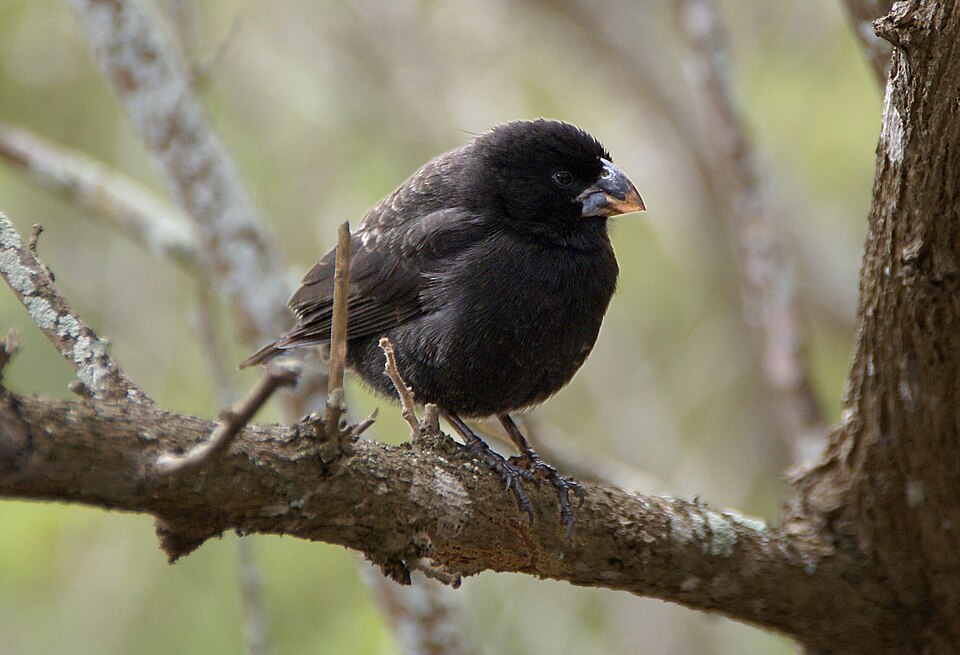
Few birds in scientific history are as famous as Darwin's finches. When young naturalist Charles Darwin visited the Galápagos Islands aboard HMS Beagle in 1835, he initially thought the small dark birds hopping among volcanic rocks were unrelated blackbirds, wrens, and grosbeaks. Only back in London—when ornithologist John Gould examined the specimens—did the astonishing truth emerge: they were closely related species descended from a single South American ancestor!
What Are Darwin's Finches? (Spoiler: They're Actually Tanagers!)
Ironically, modern DNA studies show Darwin's 18 species of Galápagos and Cocos finches aren't true Fringillidae finches like the House Finch or European Goldfinch. Instead, they belong to the tanager family (Thraupidae)—making them cousins of South America's Saffron Finch. Yet to aviculturists and biologists worldwide, they remain the most iconic "finches" on Earth.
Adaptive Radiation: One Ancestor, 18 Specialized Beaks
Roughly two to three million years ago, a small flock of South American seed-eating ancestors arrived on the isolated Galápagos archipelago. With few competing land birds and diverse island habitats—from cactus deserts to humid cloud forests—their descendants underwent rapid adaptive radiation, evolving wildly different beaks to fill every available ecological niche:
- Large & Medium Ground Finches (Geospiza magnirostris, G. fortis): Thick, nutcracker-like conical bills built to crush tough woody seeds.
- Cactus Finches: Long, pointed beaks perfect for probing prickly pear cactus flowers and fruit without getting spiked.
- Warbler Finches: Delicate, needle-thin tweezers for gleaning tiny insects and spiders from foliage.
- Woodpecker Finch: Perhaps nature's cleverest finch—it breaks off cactus spines or twigs and wields them as tools to pry wood-boring grubs out of bark!
How Speciation Happens: Isolation & Competition
Darwin's finches demonstrate three core pillars of speciation:
- Geographic (Allopatric) Isolation: Ocean stretches separate the Galápagos islands, keeping island flocks cut off long enough to adapt to local plants, seeds, and rainfall.
- Competition & Natural Selection: When drought wipes out soft small seeds on an island like Daphne Major, Medium Ground Finches with slightly deeper, stronger beaks survive better and pass those beak genes to their chicks—an effect Peter and Rosemary Grant famously measured in real time over 40+ years!
- Reproductive & Behavioral Isolation: Even if two populations later share the same island, differences in beak shape change how males sing. Females choose mates with the song and beak matching their own species, keeping species distinct.
Meet the Strangest Cousin: The Vampire Ground Finch
On Wolf and Darwin Islands—two remote, waterless volcanic specks in the far northern Galápagos—lives the unforgettable Vampire Ground Finch (Geospiza septentrionalis). When dry months erase fresh water and seeds, this finch uses its razor-sharp bill to peck at the base of tail feathers on large nesting Nazca and Red-footed Boobies, drinking drops of blood to survive.
Biologists believe this eerie behavior evolved naturally out of an earlier habit: picking parasitic hippoboscid flies and ticks off the seabirds' backs until finches discovered blood underneath—and astonishingly, the giant boobies scarcely protest!
Explore Both Realms of Finches
Want to compare Galápagos evolution icons side-by-side with companion finches kept right here in Southern California? Browse our Interactive 25-Species Finch Encyclopedia, or read how Darwin's insights compare with San Diego's wild House Finches and Goldfinches.
Frequently Asked Questions
How many species of Darwin's finches exist today?
Modern ornithology recognizes 18 species: 17 across the Galápagos Islands and 1 on nearby Cocos Island off Costa Rica.
Can you keep Darwin's finches as pets?
No. Galápagos finches are strictly protected wild endemics inside Galápagos National Park. Fortunately, vibrant Australian and African species like Gouldians, Owls, and Zebra Finches thrive as legal captive-bred companion birds.